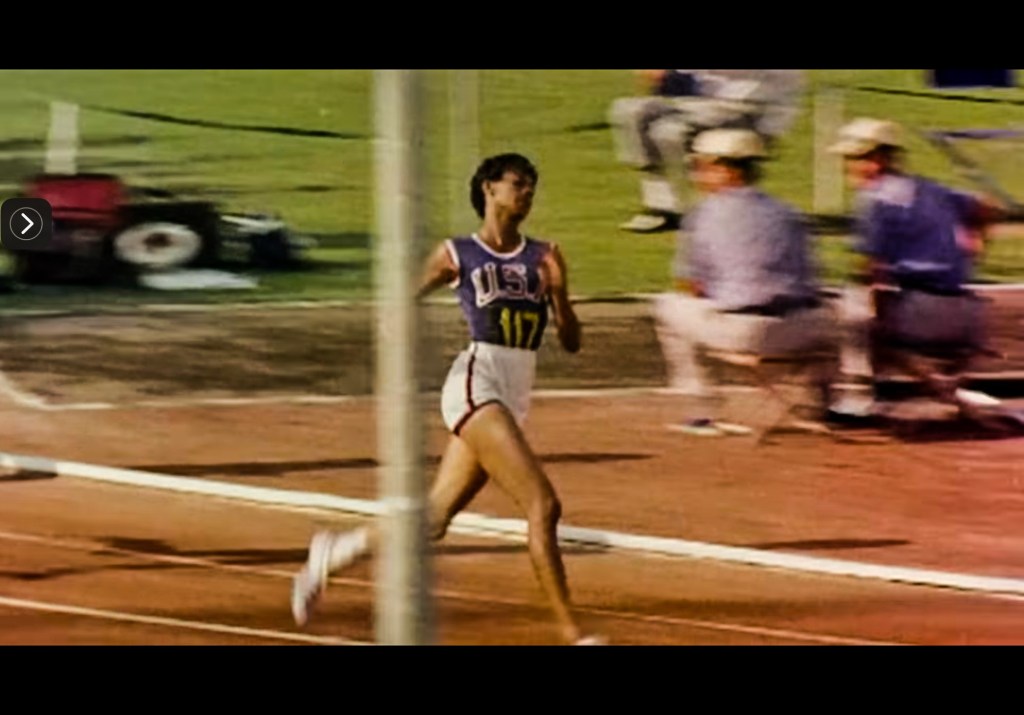
Rudolph was a handsome, regal woman, 6 feet tall, charming, graceful and gracious. Over seven days, she became the first woman to win three gold medals in track and field in one Olympics. She also became America’s greatest female sports hero since Babe Didrikson Zaharias a generation earlier. She competed which Olympic sports were completely amateur. “I love what the Olympics stand for,” she said. “They’ll always be a part of me.”

Wilma Glodean Rudolph was born on June 23, 1940, in the St. Bethlehem section of Clarksville, Tenn., The child weighed four and a half pounds at birth. At age 4, she contracted double pneumonia and scarlet fever simultaneously and almost died. The illnesses left her left leg paralyzed, and once a week, on her mother’s day off, the mother made a 90-mile round trip with her to Nashville for heat and water treatment on the leg.
At 6, she started to hop on one leg. At 8, she started to walk with a leg brace. Later, an orthopedic shoe replaced the brace. One day, when she was 11, her mother found her playing basketball in her bare feet. That was the end of the special shoe and the beginning of a fabled sports career. At 13, she went out for the high school basketball team and twice made the all-state team.
In 1956, a 16-year-old stringbean of 89 pounds, she ran in the Melbourne Olympics. To her dismay, she was eliminated in the 200-meter heats. She did win a bronze medal in the 400-meter relay. Then she returned to high school. When she graduated, Temple gave her an athletic scholarship at Tennessee State. Bulked up to 130 pounds, she made the 1960 Olympic team. Temple was the women’s coach.

The day before the 100 meters in the Rome Olympics, she stepped into a hole in the infield of the practice track and twisted an ankle. It became swollen and discolored. The next day, the ankle held up, and with her fluid running style she won her semifinal in 11.3 seconds, equaling the world record. She won the final easily in 11.0 seconds, but the following wind of 6.15 miles an hour (the allowable limit is 4.47) precluded recognition as a world record.
In the 200 meters, she set an Olympic record of 23.2 seconds in the heats and won the final easily in 24.0 seconds into a stiff wind. In the 400-meter relay, with college teammates running the first three legs, she helped set a world record of 44.4 seconds in a heat. In the final, after a bad baton pass to her, she turned a two-yard deficit into a three-yard victory in 44.5 seconds.

“After the playing of ‘The Star-Spangled Banner,’ ” she wrote in her autobiography, “I came away from the victory stand and I was mobbed. People were jumping all over me, putting microphones into my face, pounding my back, and I couldn’t believe it.” She returned to college and earned a degree in education in 1961. She was voted the 1961 Sullivan Award as America’s outstanding amateur athlete, male or female.
She taught second grade and coached high school basketball and track in Tennessee, all for $400 a month. Then she ran a community center in Indiana for $600 a month. At DePauw University in Indiana, she coached briefly and recruited minority-group students. She established the Wilma Rudolph Foundation, working with youngsters and sending tutors to schools. “If I have anything to leave,” she said, “the foundation is my legacy.
She was voted into the National Track and Field Hall of Fame, the Helms Hall of Fame, the Women’s Sports Foundation Hall of Fame and the Black Athletes Hall of Fame. In 1988, Tennessee State named an indoor track in her honor. In 1990, she became the first woman to receive the National Collegiate Athletic Association’s Silver Anniversary Award, even though she competed before the N.C.A.A. sponsored women’s championships in any sport. SOURCE NEW YORK TIMES
 Doggedly Yours