The Rosetta Stone was discovered on, or about July 15, 1799 by a member of Napoleon’s Egyptian expeditionary force. The Stone is a stela fragment carved during the reign of Ptolemy V (205-180 b.c.) and is inscribed in two different languages with three different scripts—hieroglyphic, demotic, and Greek. The importance of this artifact as a potential key for deciphering hieroglyphics was immediately recognized and then confirmed when a translation of the Greek established that the other two scripts contained the same message. News of the discovery created a sensation, spawning renewed efforts at decipherment that culminated in the success of Jean-François Champollion (1790-1832).
&&& Radio Show &&&
On Monday July 15, 2024, at 8:00 AM ( Alaska Time), on our local public radio show the transformative discovery of the ancient Rosetta rock is celebrated with the transformational music of oldies rock for the 1950’s. Listen live on102.7fm, or 103.1fm. or https://www.ktoo.org/listen/krnn/
++&& ## && ++
In case you are not able to listen to radio show, here is the playlist in three minutes. Enjoy,
~~~ §§§ ~~~
The expedition’s most memorable discovery was made by the army in July 1799. During construction of Fort St. Julien at port el-Rashid (ancient Rosetta) in the Nile Delta, engineering officer Pierre-François Xavier Bouchard (1772-1832) uncovered an irregularly shaped, dark-gray slab that he immediately identified as a stela fragment inscribed with three different scripts. When translation of the Greek established that the other two scripts recorded the same message, news of what might be the key to unraveling the mystery of hieroglyphics quickly spread.
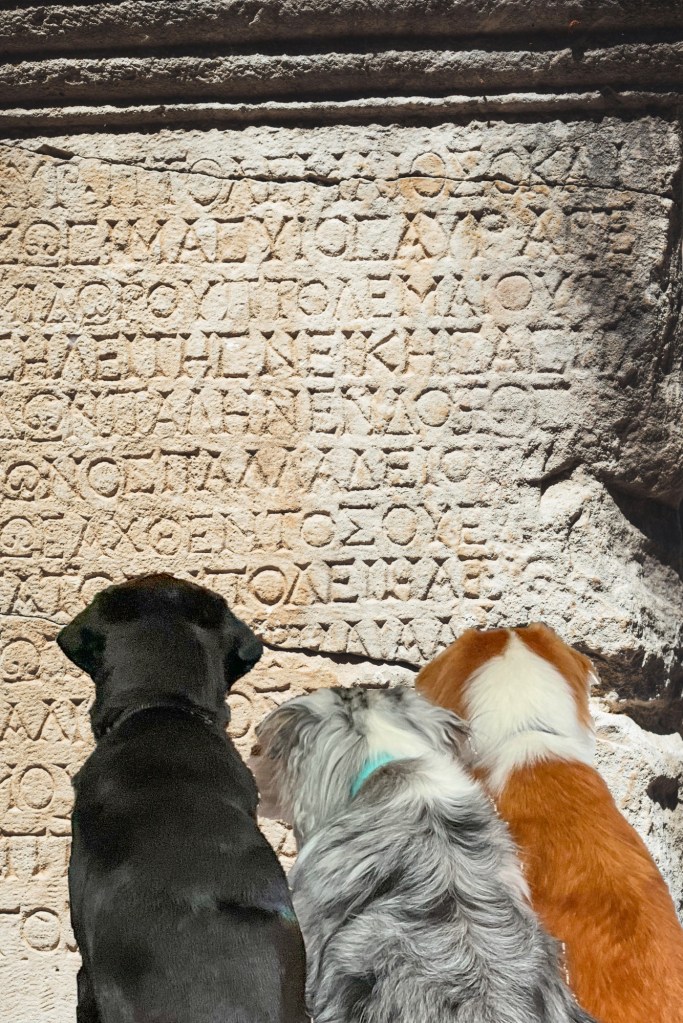
Many copies of the inscription and casts of the fragment were quickly made and distributed. Copies reached Paris in the fall of 1800, but when the French surrendered to the British in Egypt in 1801, the Rosetta Stone passed into British hands and was officially donated to the British Museum in June 1802.
The key to deciphering hieroglyphics was at last provided by the brilliant French linguist Jean-François Champollion. Highly precocious, his fascination with Egypt began at an early age when he heard stories of the Rosetta Stone’s discovery. In 1806, at age 16, Champollion presented a paper before the Société des Sciences et Arts de Grenoble arguing that Coptic was the language of Ancient Egypt. He then went to Paris in 1807 to study Arabic with Sacy and to acquire fuller knowledge of other languages considered relevant for solving the puzzle of hieroglyphics.
In 1821–22 Champollion, starting where Young left off, began to publish papers on the decipherment of hieratic and hieroglyphic writing based on study of the Rosetta Stone and eventually established an entire list of signs with their Greek equivalents. He was the first Egyptologist to realize that some of the signs were alphabetic, some syllabic, and some determinative, standing for the whole idea or object previously expressed. He also established that the hieroglyphic text of the Rosetta Stone was a translation from the Greek, not, as had been thought, the reverse. The work of these two men established the basis for the translation of all future Egyptian hieroglyphic texts. SOURCE: Britannica, Encyclopedia .com
 Doggedly Yours