
NOBEL PRIZE – On 27 November 1895, Alfred Nobel signed his will and testament, giving most of his fortune to awards– the Nobel Prizes -in physics, chemistry, physiology or medicine, literature and peace. If the Nobel Prize is in your future, then John has just the playlist on Crosscurrents, Monday, November 27 at 8:00 AM. Listen live at www.KRNN.org, 102.7fm, or 103.1fm.
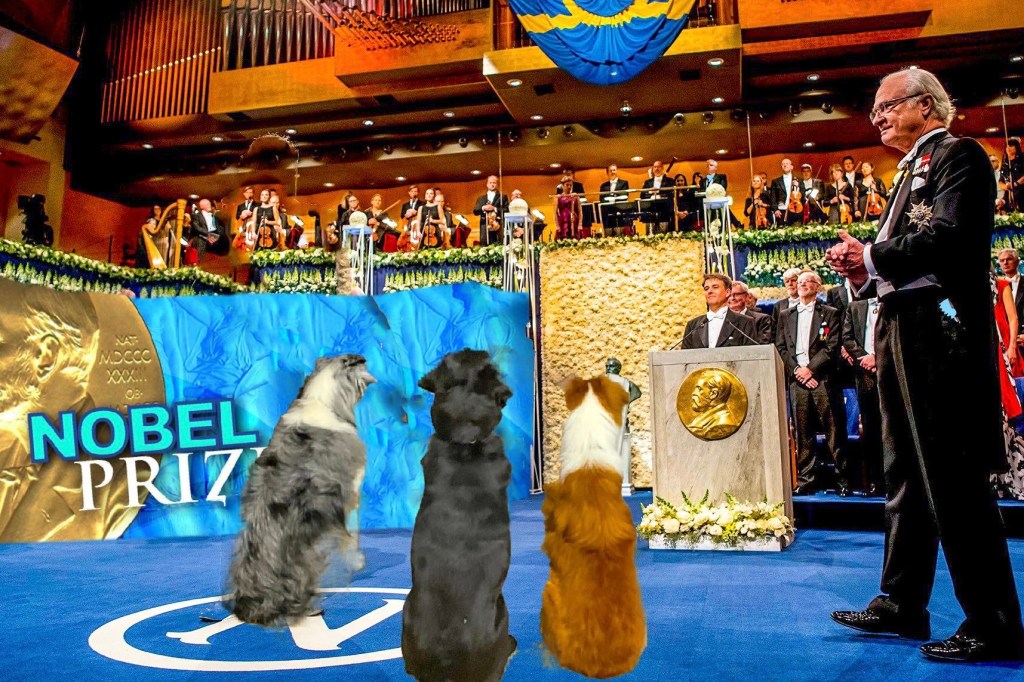
On 27 November 1895, Alfred Nobel signed his last will and testament, giving the largest share of his fortune to a series of prizes in physics, chemistry, physiology or medicine, literature and peace – the Nobel Prizes.
In 1867, Nobel accidentally discovered that when nitroglycerin dripped on kieselguhr, a silicon-containing earth, it formed a paste that was stable and safer to use than liquid nitroglycerin alone. Nobel called it dynamite, patented it and began building factories to make it in Europe.
Swedes were astonished that Nobel prepared his will unaided and without consulting the executors of his estate and the institutions that he entrusted to make the awards. He even left his fortune to a nonexistent foundation that his executors had to create posthumously.
Nobel winners are selected for their discoveries, not their I.Q.’s, and most are not geniuses, said one Nobel laureate, Dr. Michael S. Brown of the University of Texas Southwestern Medical Center in Dallas.
Illustrating his point with a humorous anecdote, Dr. Brown recalled a moment when laureates met in Stockholm at the centennial of the Nobel Prizes: “If you really want to know what Nobel Prize winners are like, you should have been in the breakfast line seeing all these brilliant people wandering around randomly trying to find the scrambled eggs. It was like anything but a group of brilliant folks.”
After divvying up portions of his wealth, Nobel dictated that the entirety of his remaining estate be used for “prizes to those who, during the preceding year, have conferred the greatest benefit to humankind.” When Nobel died a year later, his family and the executors of the will initially refused to follow his request, and the first Nobel Prize wasn’t awarded until 1901.


You’re highly welcome 💙
LikeLiked by 1 person
Thank you so much.
LikeLiked by 1 person
Inventive but not necessarily smart? Hmmm just brilliant in ways most people can’t conceive.
LikeLiked by 1 person
The post is really interesting and the anecdote is brilliant
LikeLiked by 1 person