The reason that Leif Erikson’s name is still remembered today — and the reason you’re reading this article — is because he and his Viking crew were probably the first European fellas to step foot on North American shores, thereby bridging a distance that hadn’t been bridged in eons. Not that they called this unknown place “North America,” of course … or even necessarily realized the landmark nature of their accomplishment.
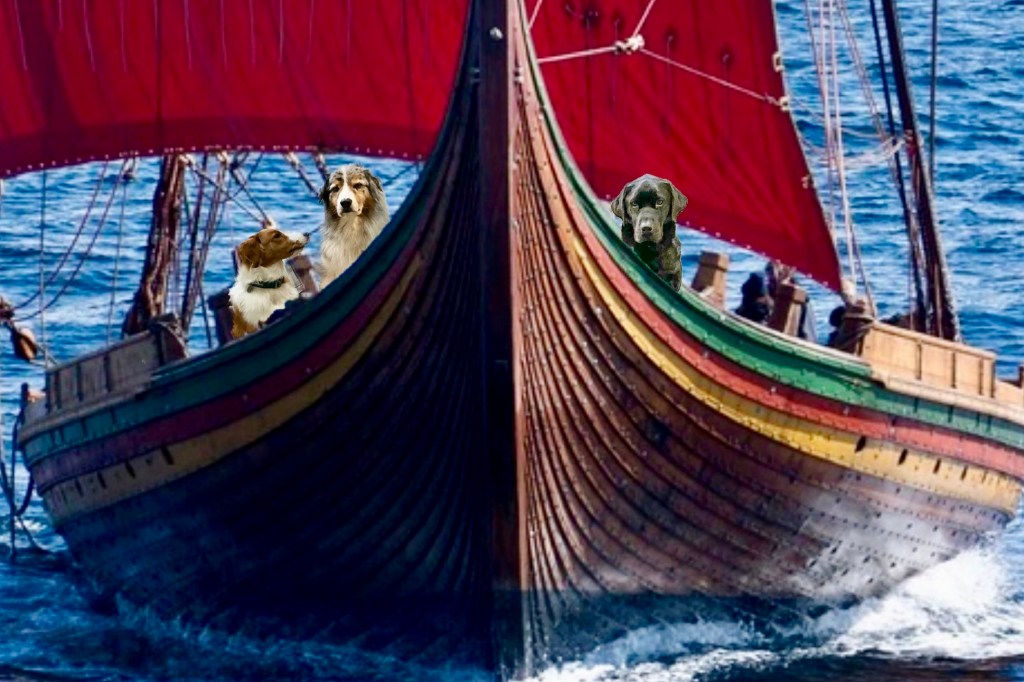
Erikson and his gang, according to Encyclopedia Britannica, seem to have dropped their anchors on the western side of the Atlantic sometime around 1000 CE. Whether Erikson’s arrival was intentional or accidental is a point of historical dispute, but it’s generally agreed that he hit up three separate locations in Canada, which he named Helluland (Land of Flat Rocks), Markland (Land of Forests), and most famously, Vinland (Land of Wine). Leif and crew were pretty amazed by Vinland. Winter was coming, so they presumably spent the season in Vinland — without encountering any of the indigenous people already living in the region — and once the sun came back out, they sailed home.
As Time Magazine explains, there isn’t a huge amount of evidence. That’s not to say this voyage didn’t happen — proven by the remains of a Viking settlement discovered in modern-day Newfoundland — but the fine details of said voyage are hard to pinpoint. The only real sources are two accounts, titled Erik the Red’s Saga, and the Saga of the Greenlanders, according to the Ancient History Encyclopedia, both of which were written centuries after Erikson’s death.
~~ N.S.R. Promo # 2 ~~

The evils of European colonialism, and the countless lives that suffered from it, are too numerous to list. However, in regard to the legend of Leif Erikson, it’s important to point out, as Biography does, that while he and his crew were indeed probably the first Europeans to hit North America, they did not colonize any of the locations they landed, but merely set up a temporary village for the winter. Erikson, as previously mentioned, seems to have not personally encountered any of the Native American people who lived on the continent. While Erikson only enjoyed one North American vacation in his lifetime, his brothers Thorvald Eriksson and Freydis Eiríksdóttir did return, however, they didn’t truly colonize the region, either. This isn’t to say that the Vikings didn’t have their own whole problematic history of colonization, slavery, and marginalization of other people — they certainly did — just that they didn’t do it in North America.
~~ N.S.R. Promo # 1~~

As for Vinland, well, it almost certainly was in northern Newfoundland’s L’Anse aux Meadows. Why the certainty? Because in 1960, as Time writes, the wife/husband team of Anne Stine and Helge Ingstad found the remains of Erikson’s little Viking village there. They had pinpointed this location based on a 1670s Icelandic map, and when they got there, were surprised by how “absurdly easy” it was to find the settlement — all they had to do was ask the locals about odd ruins, and said ruins were pointed out to them.
However, as Time Magazine points out, the history of this day, sadly, has its own racism problems. The early 20th century, there was a big movement to recognize Erikson over Columbus, not because of the facts, but instead, because the Scandinavian Erikson was supposedly “whiter” than the Italian Columbus. Thus, while there was a big push for a Leif Erikson Day over a Columbus Day, the reasons for this push were deeply troubling.
In the end, though Leif Erikson’s role in the history books is complex, and the personal details have been blurred by time and fable, it’s quite likely that his name will live on for centuries to come. SOURCE : https://www.grunge.com/232457/how-leif-erikson-became-a-legend/
 Doggedly Yours
Got to take the bad facts along with the good facts. Thanks for reading.
LikeLiked by 1 person
“Whiter” but not “better.” It’s good to remember, as long as we remember and honor for the right reasons. And with something from this long ago, it is truly difficult to get all the facts right. Thanks for another interesting history lesson.
LikeLiked by 1 person